


Land
Your Perc Test Decides Where the House Goes, Not Just the Septic
Most land buyers treat the soil test as a formality between contract and closing. It is the single result most likely to move your barndominium, redraw your driveway, and change which plan actually fits your lot.
American Barndos — August 21, 2026 — 12 min read
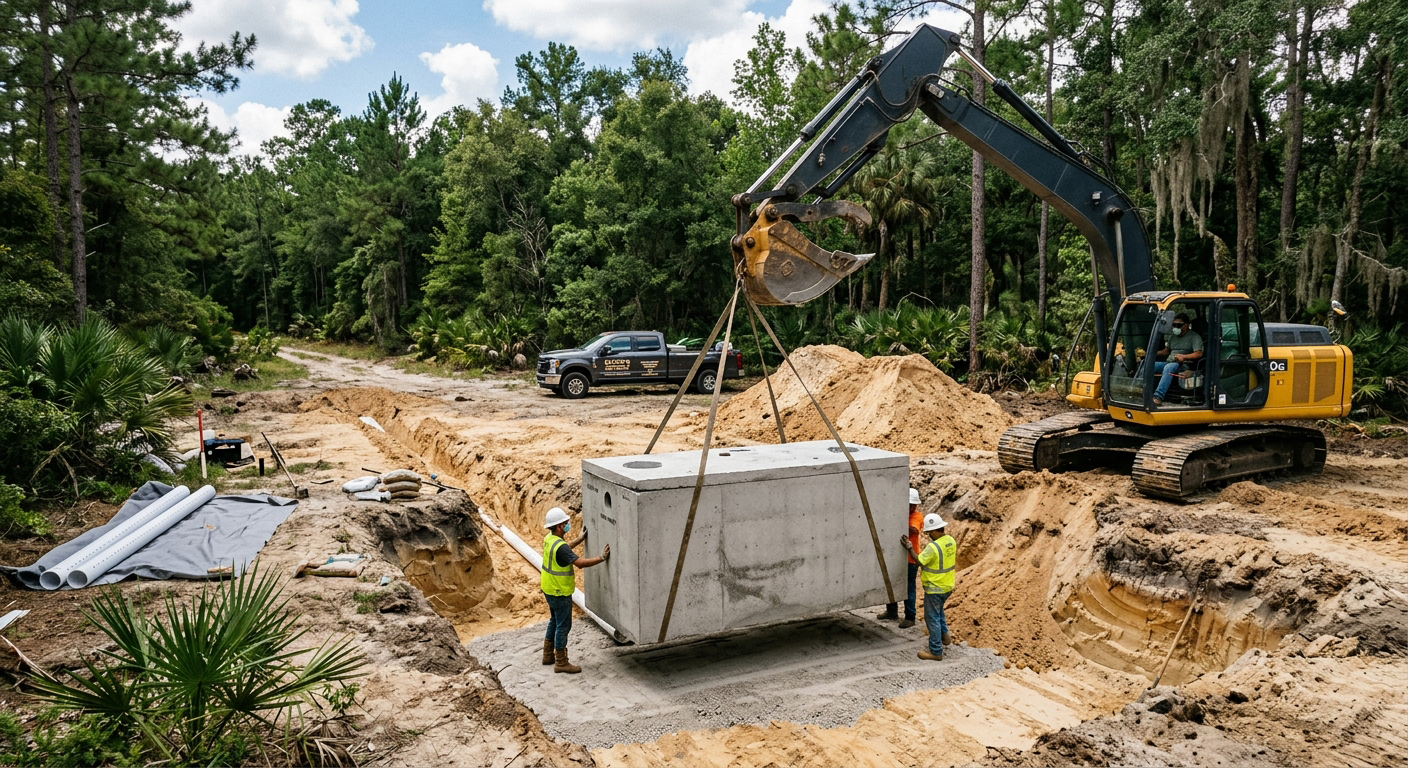
Most land buyers treat the soil test as a formality between contract and closing. It is the single result most likely to move your barndominium, redraw your driveway, and change which plan actually fits your lot.
Start here
The perc test is the cheapest test on your entire project and the one with the widest consequences. It costs a few hundred to a few thousand dollars. Its outcome swings a line item by tens of thousands, decides whether you can put the house where you pictured it, and in a small but real number of cases decides whether the lot is buildable at all.
Most people learn this in the wrong order. They fall in love with a lot, fall in love with a plan, and then find out what the soil will accept. By then both decisions are emotional and the soil is the only party in the negotiation that cannot compromise.
So this article covers what the test measures, what each possible result costs, when you are allowed to run it, and the part almost nobody writes about: how the drain field location cascades into your house siting, your driveway, and where a crane or a truss delivery can physically park during your shell.
What a perc test actually measures
A percolation test measures how fast soil accepts water. A hole is dug, presoaked, filled with water, and the drop in water level is timed. The result is expressed in minutes per inch, abbreviated MPI. It is the number of minutes it takes the water level to fall one inch.
Faster soil has a lower MPI. Slower soil has a higher MPI. That is the whole concept.
The test people confuse it with. Many jurisdictions also require a deep hole test, sometimes called a soil profile or a pit test. That is a different thing with a different purpose. A backhoe digs seven to ten feet down and a soil scientist or health department official reads the soil layers visually, looking for bedrock, hardpan, and soil mottling, which is the color streaking that reveals how high the water table climbs seasonally.
The two tests answer two different questions. The perc test asks how fast the soil drinks. The deep hole test asks how much usable soil there is before you hit rock or water. A lot can pass one and fail the other, and the deep hole test is the one that more often kills a site outright, because you cannot engineer your way past bedrock at fourteen inches as cheaply as you can engineer your way past slow clay.
Ask which tests your county requires. Budget for both.
What the number means
Typical thresholds, and note that your local maximum is set by your health department and commonly falls somewhere between 30 and 120 MPI:
| Perc rate | What it usually means |
|---|---|
| Under 5 MPI | Soil drains too fast. Effluent moves through before it is treated. Alternative or enhanced treatment often required. |
| 5 to 60 MPI | The usable band. A conventional gravity drain field is generally acceptable. |
| 60 to 120 MPI | Slow soil. Alternative system likely, depending on your jurisdiction's ceiling. |
| Over 120 MPI | Very poor drainage. Enhanced treatment system, larger field, or both. |
Two things surprise people here. First, soil can fail for being too fast, not only too slow. Sandy lots are not automatically good news. Second, there is no national standard. The exact ceiling, the required number of test holes, and who is allowed to witness the test are all local.
What each result costs
This is the part worth internalizing before you make an offer on land, because the gap between the best case and the worst case is larger than most people's entire finish budget.
The testing itself. A hand dug perc test commonly runs $200 to $1,500. When an excavator is required, which is normal for deep hole testing, expect $500 to $3,000 or more. Individual holes run roughly $100 to $500 depending on depth. If your site needs an engineered design, engineering fees typically add $1,000 to $3,000, and permits and inspections add another $500 to $2,000.
The system. This is where the number lands.
| System | Typical installed cost, 2026 | When it is required |
|---|---|---|
| Conventional gravity drain field | $3,000 to $8,000 | Good soil, adequate depth to water table and bedrock |
| Recirculating sand filter | $15,000 to $25,000 and up | Marginal soil or site constraints |
| Aerobic treatment unit | $20,000 to $40,000 and up | Poor soil, small lots, sensitive receiving environments |
| Mound system | Roughly $10,000 to $50,000 | High water table, shallow bedrock, or a failed perc |
That mound range is wide, and the width is the point rather than sloppiness in the sourcing. Published 2026 figures vary from about $10,000 at the small and simple end to $50,000 and up on difficult sites. A mound is engineered per site, so there is no such thing as a mound price until someone has designed yours.
The number that actually matters is not the mound price. It is the delta. Going from a conventional field to a mound is commonly a $15,000 to $30,000 swing against a budget that was probably built assuming conventional. If you carried a ten percent contingency and this one result consumes half of it before framing starts, you have a problem that will not show up until month six.
And it does not end at installation. A mound runs a dosing pump, which means electricity, a control panel, and a component that fails. Pump and electrical installation adds roughly $1,500 to $3,500. The pump itself needs replacement every ten to fifteen years at $500 to $1,500. Tank pumping moves to every two to three years instead of every three to five. Annual inspection runs $150 to $450. None of that is catastrophic, but it is a permanent operating cost attached to a house that was sold to you as low maintenance rural living.
When you are allowed to test
Run the test early. Not after closing, and not after you have picked a plan.
The timing rule is more specific than most people expect, and it is the opposite of what intuition suggests. Dry soil percs well. Saturated soil percs badly. Because a septic system has to work in every season, many health departments deliberately restrict testing to a defined wet season window, so the result reflects worst case conditions rather than best case. Others allow year round testing. Some suspend testing entirely during parts of the year and open an application period before the window starts.
Frozen ground is a practical constraint more than a universal prohibition. Testing below the frost line is often acceptable if the hole is protected from freezing before the test is run, but plenty of jurisdictions simply will not schedule field work in winter. The honest version is that the calendar is set by your county, not by the weather, and in some counties missing the application window means waiting until next year.
That is the real risk in the timing question. Not a bad result. A delay measured in seasons, on a lot you are already paying for.
A passing result usually stays valid two to five years, depending on the jurisdiction, and it generally runs with the land rather than with the owner. That has two practical consequences. A lot that already has a recent passing test is worth more than an identical lot without one, and you should ask for the paperwork before you assume it exists. And if you are testing before you close, structure it as a contingency, because a failed perc on land you already own is a very different conversation than a failed perc on land you have not bought.
The part nobody writes about: the field decides the house
Here is where this stops being a plumbing article.
A drain field is not a small object tucked behind the house. It is a protected zone with legally enforced clearances around it, and it cannot have vehicles, structures, or trees on it, ever. On top of that, most jurisdictions require you to set aside a reserve area, a second location that meets the same standards as the primary field, held in case the first one fails. So you are not siting one field. You are siting two.
Typical minimum setbacks look roughly like this, and again, yours are local:
| From | Septic tank | Drain field |
|---|---|---|
| House | 10 ft | 10 to 20 ft |
| Property line | 10 ft | 10 ft |
| Private well | 50 ft | 50 to 100 ft |
| Open water | 50 to 100 ft | 100 ft |
Now add scale. A mound for a three bedroom house commonly measures around 30 feet by 60 feet and stands three to four feet above natural grade. Call it 1,800 to 2,000 square feet of permanently reserved, elevated, undrivable ground, plus its own setbacks, plus a reserve area.
Work through what that actually does to a barndominium site plan.
It moves the house. The field goes where the soil is, not where the view is. If the best soil is on the side of the lot you pictured the porch facing, something is going to move, and it will not be the soil.
It moves the driveway. You cannot run a driveway across a drain field, and you cannot run one across the reserve area either. On a narrow lot, the field location can force the driveway to the opposite side of the house from the shop doors, which is a functional problem for a building whose entire purpose is getting equipment in and out.
It moves the well. Well to field setbacks are the largest on the list. On a small acreage, the well location and the field location together can consume most of the buildable geometry before the house is even placed.
It decides where heavy equipment can stage. This is the one owner builders discover the expensive way. During the shell, you will have truss delivery, a crane or a telehandler, concrete trucks, and a material laydown area. None of that can sit on a finished drain field, and on a mound, none of it can sit on the mound at any point in its life. If the field is installed before the shell goes up and it sits between the road and the build site, you have created an access problem that costs real money to work around, sometimes including a temporary access route you have to build and then remove.
It can change which plan fits. This is the connection back to the drawing. A wide, shallow footprint and a long, narrow footprint occupy the same square footage and consume very different parts of a lot. Once the field, the reserve area, the well, and their setbacks are drawn, the remaining envelope sometimes only accommodates one of those shapes. Buyers who pick the plan first and test the soil second are the ones who end up paying to modify a plan that would have been the wrong plan for the lot regardless.
The sequence that avoids all of this is unglamorous: test the soil, get the field and reserve area located on a site plan, then choose the plan that fits what is left.
What to ask your health department
Every rule above varies by jurisdiction, and the fastest way to get accurate answers is to ask the people who will actually issue the permit. Call before you make an offer. Ask these:
- Which tests do you require, perc, deep hole, or both, and who is authorized to perform them?
- Is there a seasonal testing window, and when does the application period open?
- What is your maximum acceptable perc rate, and what is the minimum depth to bedrock and to seasonal high water table?
- Do you require a reserve area, and what are its standards?
- What are your setbacks from the well, the property line, the foundation, and surface water?
- How long does a passing result stay valid, and does it transfer with the property?
- Are there any parcel specific overlays here, such as a watershed district, a wellhead protection area, or a shoreland zone, that impose stricter rules than the county baseline?
- What is the current turnaround time from application to approved design?
Write the answers down. Question seven is the one that catches people, because an overlay district can quietly impose a standard that has nothing to do with your soil and everything to do with a map you have never seen.
Before you buy the land
- Ask whether a perc or soil test already exists, and how old it is.
- If it does not exist, make the offer contingent on a passing result, with the testing window written into the timeline so a seasonal restriction does not run out the clock on your contingency.
- Budget the test and the deep hole test as separate line items.
- Budget the system at the honest range for the soil you are likely to find, not the conventional number, until you have a result.
- Get the field, reserve area, and well located on a site plan before you commit to a house plan.
- Add the delta between conventional and engineered to your contingency thinking. It is one of the few line items that can move by twenty thousand dollars on a single test result.
A note on scope
This article is general education for people evaluating rural land for a barndominium. Septic regulation is state and county specific, and in many places parcel specific. Nothing here is a substitute for your local health department, a licensed soil scientist or engineer, or a septic designer who has physically looked at your lot. Costs cited are typical published ranges as of 2026 and vary substantially by market, site, and system size.
American Barndos sells architectural design documents. We do not design septic systems and our plan sets do not include one.
Ready to look at plans?
Once you know where the field goes, you know what shape of house your lot will hold. Browse plans by footprint, clear span, and shop configuration to find one that fits the envelope you actually have.
Related reading: Ten ways an owner built barndominium goes over budget. Buying land for a barndo: setbacks, soil, and five things that kill a site.
Sources
Cost figures, percolation rate thresholds, setback distances, and testing timing in this article are drawn from the following published references, accessed August 2026. All figures are national typical ranges and are superseded by your local health department's requirements.
- HomeGuide, "How Much Does a Perc Test Cost? (2026)": perc test and per hole cost ranges, test depth pricing, result validity period. https://homeguide.com/costs/perc-test-cost
- HomeGuide, "How Much Does an Engineered Septic System Cost? (2026)": installed cost ranges for aerobic treatment units, mound systems, and recirculating sand filters; engineering fees; permit and inspection costs; annual maintenance costs. https://homeguide.com/costs/engineered-septic-system-cost
- BuildingAdvisor, "Perc Testing and Soil Testing: What You Need to Know": distinction between the percolation test and the deep hole or soil profile test, percolation rate bands in minutes per inch, setback tables, reserve field standards. https://buildingadvisor.com/buying-land/septic-systems/soil-and-perc-testing/
- BuildingAdvisor, "Best Time of Year for Perc Test?": seasonal testing windows, wet season requirements, frozen ground and frost line considerations, validity period and transferability with the land. https://buildingadvisor.com/best-time-of-year-for-perc-test/
- Septic Tank Hub, "Mound Septic Systems: Cost, When They're Required, and How They Work": mound system trigger conditions, footprint dimensions, dosing pump and electrical costs, pump replacement interval, maintenance cadence, and service life. https://www.septictankhub.com/blog/mound-septic-systems/
Note on the mound cost range: sources two and five publish materially different figures, roughly $25,000 to $50,000 and roughly $10,000 to $25,000 respectively. Both are reported above as a combined range rather than averaged, because a mound is engineered per site and no single figure is meaningful without a design.
Founding list
Join the founding list.
The catalog opens to the founding list first, at founding pricing, before it goes public.