


Land
"Utilities available" is not "utilities connected," and the gap is measured in feet
The listing says power is at the road. The road is 1,800 feet from where you want the house. Depending on which side of one cooperative's free allowance you land, that sentence is worth either nothing or forty thousand dollars, and nobody tells you which until you ask in writing.
American Barndos Editorial — August 21, 2026 — 13 min read
Start here
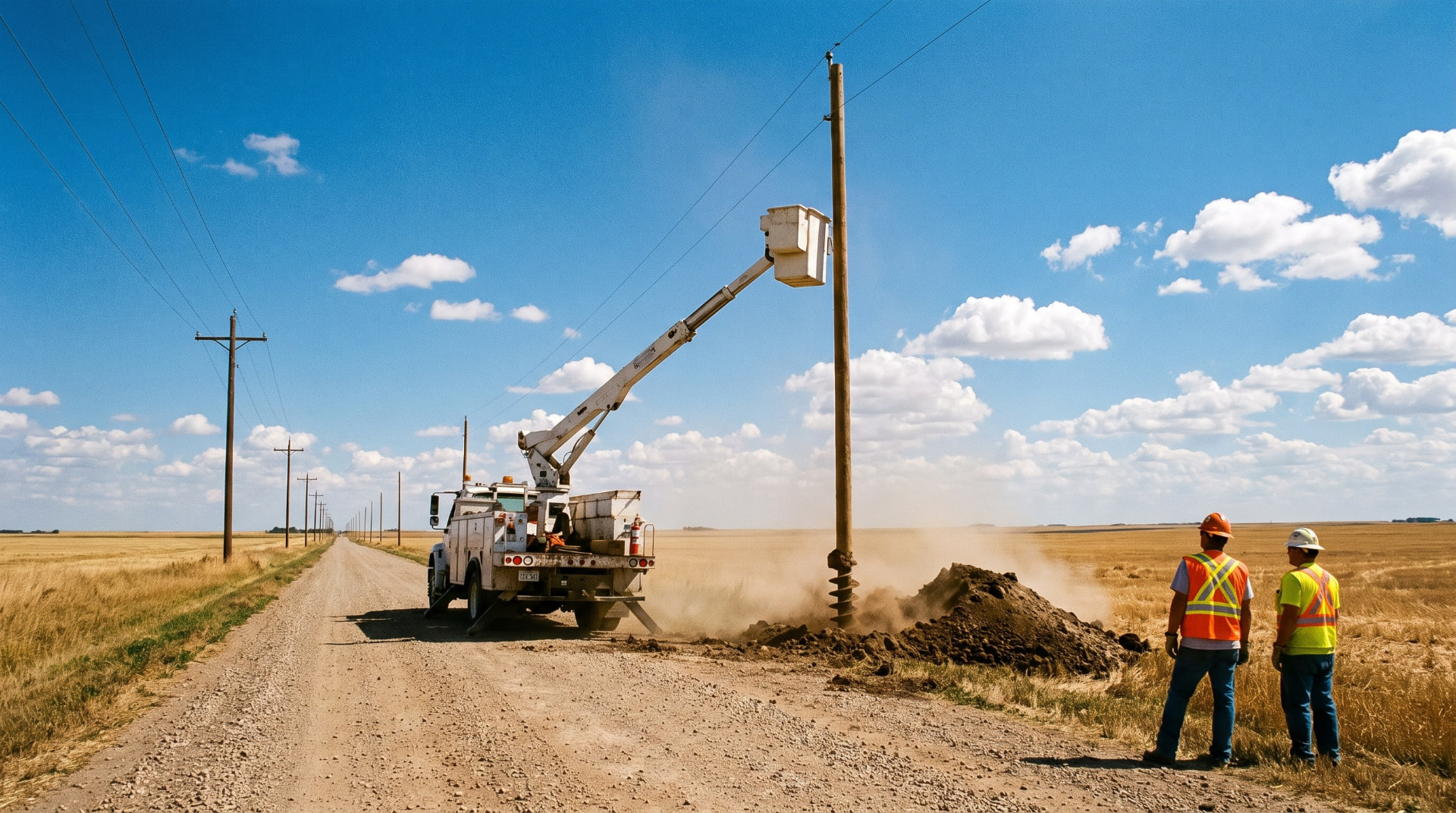
Every rural land listing uses the same three words. Utilities available. It is not a lie and it is not information. It means a line exists somewhere in the vicinity. It says nothing about the distance from that line to your building site, nothing about what your provider charges past its free allowance, and nothing about whether the route crosses land you do not own.
The number that matters is not whether power exists. It is the distance from the nearest serviceable point to your meter, and the per foot rate past whatever your provider gives you for free. Those two figures produce a range from zero to well over fifty thousand dollars on parcels that look identical in a listing.
This article covers what each utility actually costs to bring in, the permanent easement you grant across your own land to get electricity to your own house, and the order the work has to happen in. It does not cover septic, which has its own article, and it does not cover setbacks or easements you inherit from somebody else, which has its own article too.
Electric: the line extension is the whole question
Most rural electric providers, especially cooperatives, run a defined length of line at no charge and then bill per foot beyond it. The free allowance is the single variable with the widest financial consequence on the entire parcel, and it is not standardized.
Here is one cooperative's published tariff, quoted because it shows the structure clearly rather than because your provider will match it.
| Service type | Pioneer Electric published rate |
|---|---|
| Free allowance | No line extension cost for up to a quarter mile of line |
| Single phase, overhead | $6.50 per foot beyond the allowance |
| Single phase, underground | $10.00 per foot beyond the allowance |
| Three phase, overhead | $9.50 per foot beyond the allowance |
| Three phase, underground | $15.00 per foot beyond the allowance |
That co-op also offers payment over 60 months or a discounted lump sum.
Now the national picture, which is materially harsher.
| Item | Typical published range, 2026 |
|---|---|
| Overhead service line, installed | $5 to $15 per foot |
| Underground service line, installed | $10 to $25 per foot |
| Rural extension beyond the free allowance | $10 to $50 per foot |
| A quarter mile run beyond the allowance | $13,000 to $66,000 |
| Overhead, per mile installed | $42,000 to $79,000 |
| 500 feet, overhead | $4,000 to $7,500 |
| 500 feet, underground | $5,000 to $12,500 |
| Trenching alone | $5 to $12 per foot |
| Conduit, excluding trenching | $4 to $8 per foot |
| Utility poles | $1,200 to $5,600 per pole |
| Residential transformer, installed | $3,000 to $20,000 and up |
| Meter box | $500 to $2,100 |
| Electrical panel | $850 to $2,500 |
Two structural details worth internalizing.
Pole spacing sets the pole count. Poles span roughly 300 feet in rural areas. A half mile of overhead line is not one pole, it is eight or nine, and the pole charge above is per pole.
Most providers require a transformer within about 150 feet of the house. That constrains where the line has to terminate, which in turn constrains where the house can go if you are trying to minimize footage.
On the conflicting numbers above: the cooperative tariff and the national contractor ranges disagree by a wide margin, roughly $6.50 per foot against $10 to $50 per foot. Both are reported rather than averaged because they measure different things. A regulated co-op tariff is a published rate to members with a free allowance built in. The national ranges reflect market and contractor pricing on jobs that frequently include trenching, conduit, poles, and a transformer as separate line items. The only number that means anything is a written extension estimate to your exact parcel, from your actual provider, with the free allowance stated. Ask for it before you make an offer. It is free and it takes one phone call.
The part nobody writes about: you grant a permanent easement across your own land
Here is the consequence almost nobody explains before the lineman is already walking the property with a flag.
To bring power to your house, you grant the utility a recorded easement across your own land. It is a legal agreement between you and the provider, and it is not a courtesy. It is the instrument that lets them build, access, and maintain the line forever.
The corridor is wider than the wire. One cooperative publishes these right of way widths:
| Line type | Right of way width |
|---|---|
| Distribution lines | 30 feet total, 15 feet each side of centerline |
| 69 kV transmission | 50 feet total, 25 feet each side |
| 138 kV transmission | 100 feet total, 50 feet each side |
Your service drop is distribution. Call it a permanent 30 foot corridor running from the road to your transformer, following whatever route gets agreed on the day someone walks the property.
You cannot build in it. Vehicles, buildings, and other permanent structures inside the easement that restrict access to the lines and equipment are prohibited. The utility also runs an active re-clearing program on vegetation, meaning trees and brush that would obstruct their activities get removed on their schedule, not yours.
Read that against the buildable envelope article and the arithmetic is obvious. A 1,500 foot service run placed carelessly across the middle of a parcel creates a 30 foot no-build strip through the middle of the parcel, permanently, and you signed it yourself. The same easement placed along a property line or a fence row costs you almost nothing, because it overlaps ground you already could not build on.
So the routing conversation is a design decision, not a formality. Before you sign the easement, walk the route with the map you used to place the house, the shop, the driveway, and the septic field. Ask whether the line can follow a boundary rather than cross the interior. Utilities generally take the cheapest route unless somebody asks for a different one, and the person who has to ask is you.
And if the route crosses somebody else's land, you need their easement too. That is the situation that turns a cost problem into a deal problem, because a neighbor who does not want a line across their pasture has no obligation to give you one. Ask early. Ask in writing. Confirm easements as part of your due diligence rather than after closing.
Water: well or municipal, and the number that moves
If municipal water reaches the parcel, connection commonly runs $25 to $200 per linear foot, or $1,000 to $6,000 and up in total, with a water meter at $300 to $800.
Most rural barndominium buyers are drilling.
What a well costs
Drilling alone commonly runs $25 to $65 per foot, with drilling-only quotes reported as low as $15 to $30 per foot. Complete installed systems run $30 to $80 and up per foot. Most homeowners pay $5,500 to $12,000 all in for a standard drilled well at average depth.
Depth is regional, and it is the multiplier.
| Region | Typical depth |
|---|---|
| Southeast | 50 to 150 feet |
| Midwest | 100 to 200 feet |
| Mid-Atlantic | 100 to 300 feet |
| New England | 150 to 400 feet |
| Southwest and Mountain West | 150 to 600 feet |
| California | 100 to 700 feet |
| Well depth | Complete system cost |
|---|---|
| 50 feet | $3,000 to $7,500 |
| 100 to 200 feet | $5,500 to $12,000 |
| 200 to 300 feet | $10,000 to $18,000 |
| 300 to 500 feet | $15,000 to $30,000 |
| 500 feet and beyond | $25,000 to $50,000 and up |
A 150 foot well breaks down roughly as: drilling $6,000, PVC casing $900 to $1,650, submersible pump $800 to $1,800, pressure tank $600 to $1,500, electrical $1,000 to $3,000, permit $100 to $500, water test $150 to $400.
Geology is the hidden variable. Hard rock runs $45 to $85 per foot against $15 to $35 per foot in soft soil. A 200 foot well through granite is around $13,000 in drilling alone versus about $5,000 in soft soil. Same depth, same well, two and a half times the price. Ask neighbors what they hit and at what depth. It is the cheapest research available and it is usually accurate within fifty feet.
The contract clause that matters. Drillers charge per foot regardless of whether they find water. Before you sign, get the contract to define your financial exposure if no water is found and what happens next. That single paragraph is the difference between a bad day and an argument.
And it does not end at installation. Twenty year ownership of a well is estimated at $14,200 to $42,000, including a pump replacement around year ten to fifteen and annual testing. Budget the well as a system with a service life, not as a one time line item.
Gas, propane, and the all-electric question
Natural gas lines run $12 to $25 per linear foot, or $350 to $2,000 total where service is close, and some providers cover the cost up to a specified footage, the same free allowance structure the electric side uses. Ask the same question you asked the electric provider.
Where natural gas does not reach, which is most rural parcels, propane is the answer. Tank installation runs $700 to $5,700 depending on size and whether the tank is above ground or buried.
The decision is worth making before the plan is finalized rather than after, because it changes appliance selection, the mechanical rough-in, and where the tank and its clearances sit on a site plan that is already competing for space with a drain field, a well, and a driveway.
Internet, which is now a utility whether or not anyone calls it one
Running cable to a remote parcel is reported at $20,000 to $250,000 and up, which is another way of saying it is not happening. The two realistic options are satellite and fixed wireless.
| Starlink | Fixed wireless (WISP) | |
|---|---|---|
| Hardware | $349, owned | $0 to $150, often leased |
| Installation | Self install, 2 to 4 hours | $0 to $100, technician |
| Monthly | $120 standard | $40 to $80 typical |
| Download | 65 to 115 Mbps standard | 25 to 200 Mbps by provider |
| Upload | 8 to 18 Mbps standard | 10 to 50 Mbps, more symmetric |
| Latency | 20 to 60 ms | 5 to 30 ms |
| Data | 1 TB priority, then deprioritized | Usually unlimited |
| Requirement | Clear sky view | Line of sight to a tower 3 to 25 miles out |
Fixed wireless is cheaper and lower latency where it is available, and a $50 per month WISP saves roughly $4,200 against Starlink standard over five years. Starlink works anywhere with sky. The practical answer is to find out whether a WISP covers the parcel and can actually see it, before you assume either.
Check this before you buy if anyone in the household works from home. It is the utility people forget to verify and the one they notice first.
Road access and the culvert permit that gates everything
You need a permit to connect a new driveway to a county road, and it is issued by the county road or public works department, separately from anything the building department does.
The application is usually simple: a site sketch, the approximate location, and the proposed width and surface type. What the county reviews is not simple. They evaluate sight distance, traffic, and drainage, and they decide whether a culvert or a special design is required and what size it has to be. Construction and a final inspection follow, and the county signs off at the end.
Gravel driveway with culvert commonly runs $15 to $60 per foot, driven by length and grading. On a parcel with the house set 800 feet off the road, that is a $12,000 to $48,000 line item that most buyers have not written down anywhere.
The sequence, because doing it out of order costs money
This is the part that separates a smooth start from a stalled one. Utilities on raw land typically take 6 to 12 weeks or more from start to finish, and the steps are dependent rather than parallel.
- Written extension estimate from the electric provider, to the exact parcel, with the free allowance stated. Before the offer, not after.
- Confirm any off-parcel easements the route requires. If a neighbor is in the path, this is a due diligence item, not a construction item.
- Driveway approach permit from the county road department. Nothing heavy reaches the building site until there is a legal, culverted, inspected approach.
- Build the driveway and culvert. The line crew's truck, the drill rig, the concrete trucks, and the truss delivery all use it.
- Sign the utility easement, with the route walked against your site plan rather than picked for the utility's convenience.
- Set temporary construction power, which is what lets the rest of the build proceed without a generator.
- Drill the well once the rig can physically reach the location, and after you know where the septic field and its reserve area are going, which is covered in its own article.
The failure mode is running these in the wrong order: drilling before the driveway exists, or signing the easement before the house is sited, or discovering at week four that the extension route needs a neighbor's signature.
What to ask before you make an offer
Call three offices and one contractor. Write down the answers and the names.
Electric provider:
- What is the nearest serviceable point to this parcel, and how many feet is it to the building site?
- What is your free allowance, and what is your per foot rate beyond it for single phase overhead and underground?
- Will you put an extension estimate in writing for this specific parcel?
- Does the route require easements from any adjoining landowner?
- What right of way width do you require, and what are the restrictions inside it?
- What is your current lead time from signed easement to energized service?
County road or public works department:
- What does a driveway approach permit require here, what is the fee, and what are the sight distance requirements at this location?
- Will a culvert be required, and who sizes it?
Water:
- Does municipal water reach this parcel, and what is the connection cost and the meter fee?
- If not, what depth are wells in this immediate area, and what is the formation?
Question four is the one that catches people. Everything else on this list is a cost. Question four is the only one that can be a hard no.
Before you buy the land
- Get a written electric extension estimate to the exact parcel, with the free allowance stated.
- Confirm whether the route crosses anyone else's property, and whether they will grant an easement.
- Walk the proposed line route against your site plan before signing anything, and push for a boundary route rather than an interior one.
- Ask the county what the driveway approach permit requires and whether a culvert is needed.
- Measure the driveway length and multiply by $15 to $60 per foot. Write the number down.
- Ask neighbors what depth their wells are and what they drilled through.
- Get the dry hole clause in writing before the rig arrives.
- Confirm whether a fixed wireless provider can actually see this parcel, if anyone works from home.
- Budget six to twelve weeks or more for utility work, and sequence the driveway before everything that has to drive on it.
A note on scope
This article is general education for people evaluating rural land for a barndominium. Line extension policies, free allowances, right of way widths, driveway permit standards, and well permitting are set by your specific provider and your county, and they vary enormously. The cooperative rates quoted are one provider's published tariff and are included to illustrate the structure, not as a benchmark for yours. Cost figures are typical published ranges as of 2026 and vary substantially by market, distance, terrain, and geology. Nothing here is a substitute for a written estimate from your actual provider, your county road department, or a licensed driller and electrician.
American Barndos sells architectural design documents. We do not install utilities, drill wells, obtain permits, or negotiate easements, and a plan set is not a site plan or a utility plan.
Ready to look at plans?
Utility cost is driven by distance, and distance is driven by where the house sits. Once you know your extension footage, your driveway length, and where the easement corridor is going, you know which building locations are affordable and which are not, and that usually narrows the plan shape too. Browse plans by footprint, clear span, and shop configuration, and download a free watermarked preview to test it against the site you can actually afford to serve.
Related reading: Is a barndominium allowed on this land? Zoning, covenants, and agricultural exemptions. Your lot lines are not your building site: setbacks, easements, and the buildable envelope. Your perc test decides where the house goes, not just the septic.
Sources
Cost figures, rates, right of way widths, and process descriptions above are drawn from the following published references, accessed September 2026. All figures are typical published ranges and are superseded by a written estimate from your actual provider and your county's own requirements.
- HomeGuide, "How Much Does It Cost to Get Utilities on Land? (2026)": total utility installation ranges, electric per linear foot, trenching, utility pole cost, city water and meter cost, well cost per foot, natural gas per linear foot and provider footage coverage, propane tank installation, permit and impact fees, remote cable extension cost, and the 6 to 12 week installation timeline. https://homeguide.com/costs/cost-to-get-utilities-on-land
- HomeGuide, "How Much Does It Cost to Run a New Electrical Service Line? (2026)": overhead versus underground per foot rates, 500 foot and per mile costs, transformer installed cost and the 150 foot proximity requirement, meter box and panel cost, trenching and conduit rates, and the note that most power companies run electric from the road free up to a certain distance. https://homeguide.com/costs/cost-to-run-power
- Pioneer Electric Cooperative, "Line Extension Cost": the quarter mile free allowance and published per foot rates for single phase and three phase, overhead and underground, plus 60 month and lump sum payment options. https://pioneerelectric.coop/my-account/help/line-extension-cost/
- Before You Buy Land, "Cost to Run Utilities to Rural Land (2026)": rural extension cost per foot beyond the free allowance, quarter mile extension range, gravel driveway and culvert cost per foot, and the guidance to obtain a written extension estimate to the exact parcel and confirm easements. https://beforeyoubuyland.org/costs/utility-hookup-cost-rural-land/
- Golden Valley Electric Association, "Easement / Right of Way": the definition of a utility easement, right of way widths for distribution and transmission lines, the utility's vegetation clearing and re-clearing program, and the prohibition on vehicles, buildings, and permanent structures within the easement. https://www.gvea.com/services/programs-services/easement-right-of-way/
- The Well Guide, "Well Drilling Cost: What Homeowners Actually Pay in 2026": per foot drilling rates, typical depth by region, complete system cost by depth, component breakdown, hard rock versus soft soil pricing, the per foot charge regardless of water found, water testing cost, and 20 year ownership cost. https://www.thewell.guide/cost-guides/well-drilling-cost
- Rural Internet Guide, "Starlink vs Fixed Wireless WISP: Complete 2026 Comparison": hardware and installation cost, monthly pricing, download and upload speeds, latency, data policies, line of sight requirements, and five year cost comparison. https://ruralinternetguide.com/starlink-vs-fixed-wireless-wisp-2026/
- ADM Dirt Works, "Driveway Approach off a County Road: Homeowner Guide": the issuing authority, application contents, what the county reviews including sight distance, traffic and drainage, the culvert determination, and the construction and final inspection requirement. https://admdirtworks.com/blog/driveway-approach-county-road-homeowner-guide
Note on the electric rate conflict: source three publishes $6.50 per foot for single phase overhead with a quarter mile free allowance, while sources one, two, and four report $5 to $50 per foot depending on construction type and whether the run is a standard service line or a rural extension. Both are reported above rather than averaged, because a regulated cooperative tariff and a market contractor estimate are different figures measuring different scopes. Only a written estimate to your parcel is meaningful.
Founding list
Join the founding list.
The catalog opens to the founding list first, at founding pricing, before it goes public.