


Financing
Your Lender Pays for Work That Is Already Finished. Your Suppliers Want Money Before They Start.
A construction loan reimburses completed work. Deposits fund work that does not exist yet. On a $400,000 build the gap between those two facts can put $37,000 to $157,000 of your own money in play at once.
American Barndos — August 21, 2026 — 12 min read
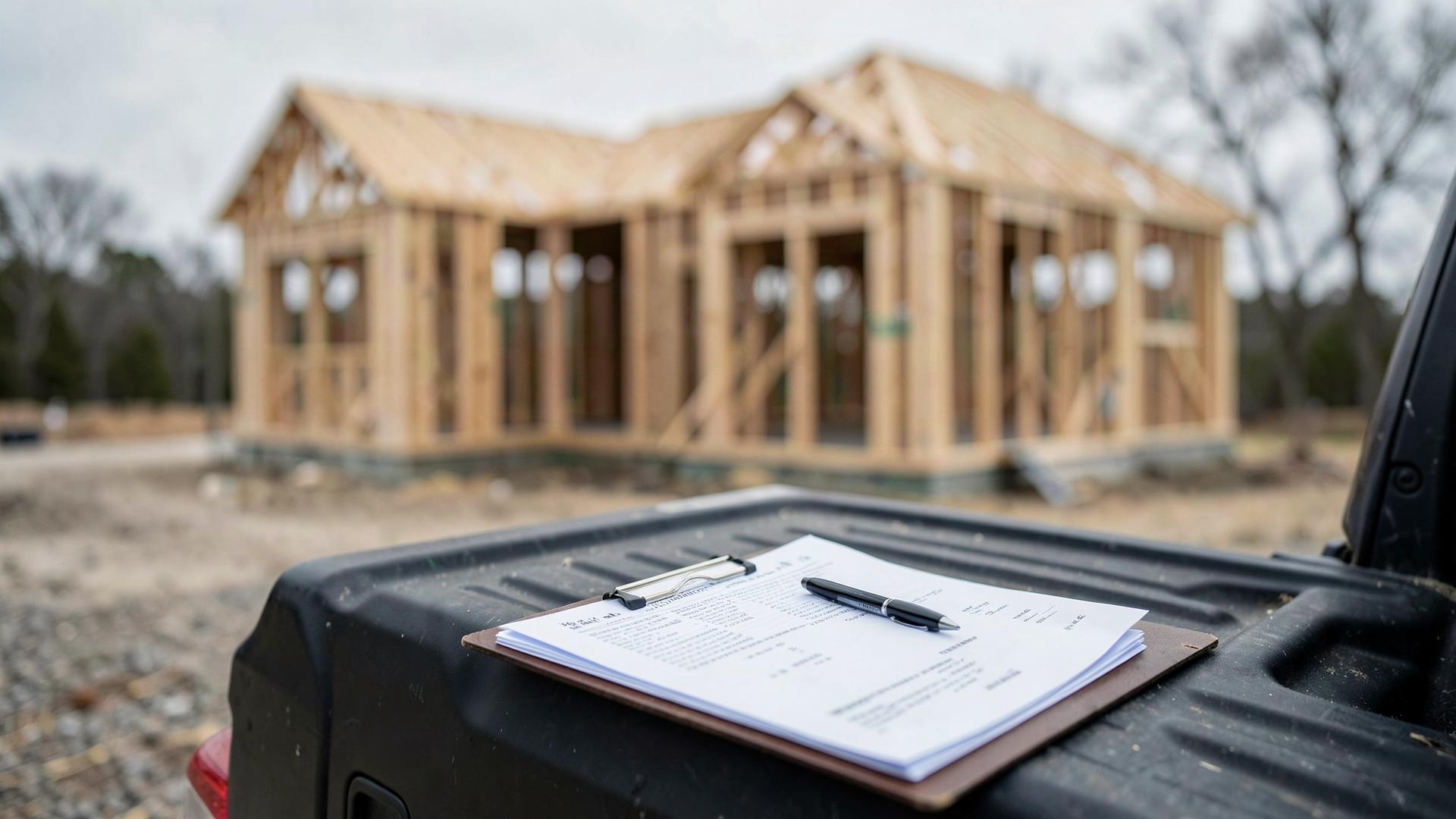
A construction loan reimburses completed work after an inspector confirms it exists. A truss order, a building package and an overhead door all want a deposit months before anything gets built. Between those two facts sits a cash gap that nobody finances, and on a $400,000 build it can peak somewhere between $37,000 and $157,000 of your own money in play at once. That gap, not the interest rate, is what ends owner built projects.
Start here
People shop construction loans on rate and approval odds. Both matter, and neither is what goes wrong.
What goes wrong is mechanical, and it comes down to one sentence: a construction loan is a reimbursement, not a bank account.
You do not receive $400,000 and spend it. The lender holds the money and releases it in pieces, each piece only after a specific stage is finished, verified by an inspector, and documented. The industry phrase is work in place. Not work ordered. Not work paid for. Not material sitting in your field. Work standing on your site, complete.
Everything in the rest of this article follows from that. The draw schedule, the inspections, the retainage, the lien waivers and the interest are all consequences of a lender who will not pay for anything that does not yet exist.
Which loan product to choose, who lends on barndominiums and what they require to approve you, belongs to the financing article and is linked at the end. What follows is what happens after you have one.
The draw schedule
A draw is one release of funds. Most residential construction loans use four to six of them, tied to milestones. A representative six draw structure looks like this, shown here against a $400,000 build.
| Draw | Stage | Share | Amount |
|---|---|---|---|
| 1 | Foundation | 15% | $60,000 |
| 2 | Framing | 30% | $120,000 |
| 3 | Dry-in, roof and windows | 12% | $48,000 |
| 4 | MEP rough-in | 18% | $72,000 |
| 5 | Interior finishes | 18% | $72,000 |
| 6 | Final and certificate of occupancy | 7% | $28,000 |
Two things to notice immediately.
Framing is 30 percent in one lump. It is by far the largest single stage, and on a post frame building it is also the stage that requires the most material to have been bought and delivered before any of it can be claimed. That combination is why the framing draw is where cash problems surface.
The final draw is small and it is last. Seven percent, released at the certificate of occupancy. Everything you spend between the last inspection and the CO comes out of your pocket first.
Your actual schedule is negotiated at closing and it is not standard. The percentages, the number of draws, and what counts as complete for each one are all in the loan documents, and they are worth reading before you sign rather than after.
The draw cycle, and how long it really takes
A draw is a process, not a button.
You submit the request. A signed draw request naming the amount, the schedule of values line items, a certification that the work is complete, and supporting documents.
You supply documentation. Lien waivers from subcontractors and suppliers, an updated schedule of values showing costs to date, photographs of the completed work, and copies of permits.
An inspector verifies it. A licensed inspector, or in some markets an appraiser, confirms the work is physically in place. Inspection typically takes two to five business days, with the report often due within 24 to 48 hours of the visit.
The lender reviews and funds. Review runs about two to four days, title endorsement one to three days, and the wire one to two days.
Total, commonly quoted as 7 to 14 business days from submission to money in the account. That is roughly 10 to 20 calendar days after the stage is already finished.
Note what that timeline starts from. The clock does not begin when the work starts. It begins when the work is done, inspected, and documented. So the money for framing arrives two to three weeks after the framing is standing, which is to say two to three weeks after the framer and the material supplier expected to be paid.
Note also who receives it. On a builder contract the funds go directly to the builder rather than to you, and on some government backed programs the lender must obtain your written approval before each disbursement. Owner built projects are the exception in every direction here, which is exactly why lenders treat them differently, and that is the financing article's territory.
One more thing about inspections. Your building department's foundation, framing and final inspections are not the same thing as the lender's inspection, though a local inspection often satisfies part of the requirement. Lenders commonly layer their own progress inspection on top. Two inspectors, two schedules, and only one of them cares about your loan.
Retainage
Retainage, sometimes called holdback, is a percentage the lender keeps back from every draw and releases at the end.
| Loan type | Typical retainage |
|---|---|
| Conventional bank | 10 percent standard |
| SBA 504 | 10 percent standard |
| HUD insured | 10 percent, strictly applied |
| USDA business and industry | 5 to 10 percent |
| Institutional and life company | 5 to 7.5 percent |
Residential lenders commonly hold 5 to 10 percent of each draw, released at the final draw together with the certificate of occupancy. Some commercial structures release it in halves, part at fifty percent completion and the balance at final acceptance.
Run that against the schedule above. On a $400,000 build at 10 percent retainage, the first five draws total $372,000 and the lender is holding $37,200 of it when you reach the final stage. At 5 percent it is $18,600.
That money is yours, it is inside your loan amount, and you cannot spend it. Which means your budget is not $400,000 during construction. It is $400,000 minus whatever retainage has accumulated, and the accumulation peaks at exactly the moment you are paying for finishes.
Lien waivers, and the one that can cost you
Every draw requires lien waivers from the people who did the work. A lien waiver is a signed document giving up the right to file a mechanic's lien against your property for that work.
There are four, and the differences are not cosmetic.
| Waiver | Takes effect | Waives | Sign it |
|---|---|---|---|
| Conditional progress | Upon payment being received | Lien rights for that period's completed work | Before payment, with the pay application |
| Unconditional progress | Immediately on signing | Lien rights for that portion of work | Only after payment has cleared |
| Conditional final | Upon final payment | All remaining lien rights | Before final payment, at closeout |
| Unconditional final | Immediately on signing | All lien rights, permanently | Only after the work is complete and paid |
Conditional waivers are self executing. Once payment is made the waiver takes effect automatically and no further action is required.
Unconditional waivers take effect the moment the pen leaves the paper, paid or not.
Which produces the trap. Somebody will occasionally ask for an unconditional waiver before payment has been made. Published guidance is blunt that this is generally not advisable, because signing before the funds clear removes the signer's leverage entirely if the payment never arrives.
Two consequences for you as the owner.
As the person collecting waivers, an unconditional waiver from a sub is the strongest protection you can hold, and it is the one that sub is least willing to sign early. Conditional waivers before payment and unconditional after is the normal, fair sequence.
As the person occasionally asked to sign one, on an owner built job where you are also performing work, read which of the four you are signing. Two of them are permanent and immediate.
Twelve states mandate specific statutory lien waiver forms: Arizona, California, Florida, Georgia, Massachusetts, Michigan, Mississippi, Missouri, Nevada, Texas, Utah and Wyoming. In those states the form is not negotiable and a homemade waiver may not do what you think it does.
Interest during construction
You pay interest only on what has actually been disbursed, not on the full loan amount. That is the one genuinely borrower friendly mechanic in the whole structure.
Two ways it gets handled:
Interest paid monthly, out of pocket, growing as draws accumulate. You feel it every month and it does not add to your loan balance.
An interest reserve, where projected construction period interest is financed into the loan itself. No out of pocket payments during the build. You are borrowing the interest, and it comes out of the same loan proceeds that were supposed to build the house.
Because interest tracks the drawn balance, the shape of your draw schedule changes what you pay. An illustration on the $400,000 schedule above, treating the six stages as equal periods over a twelve month build:
- Average outstanding balance about $257,000, or 64 percent of the budget
- Interest at 7 percent roughly $18,000
- Interest at 8 percent roughly $20,500
- Interest at 9 percent roughly $23,000
Those are illustrations of the arithmetic, not quotes and not a prediction of your rate. The point of the table is the mechanic: a build that draws early and finishes late costs materially more than the same build that draws on schedule. Every week of delay after a draw has funded is a week of interest on money that is not producing a building.
The part nobody writes about: the lender pays in arrears and the supply chain bills in advance
Everything above is the process. This is the failure, and it is the one that ends owner built projects.
The lender's rule is work in place. Materials sitting in your field can sometimes be drawn against, but only under conditions: the inspector physically inventories them, they are insured, title has transferred to you, and on site storage is typical for that item. Materials stored off site are harder still, and lenders will either not fund them at all or require a separate UCC filing. That language has to be negotiated into the loan commitment at closing, not requested later when you need the money.
And deposits are not addressed at all. A deposit is not work, it is not material on your site, and it is not something an inspector can photograph. It is money gone.
Now put that next to what the supply chain actually requires. A building package deposit is due at signed order, and the long lead items article covers why the package itself can be an 18 to 30 week item once erection drawings and submittal review stack on top of fabrication. So the deposit leaves your account roughly four to seven months before the material it bought is standing on your site and eligible for a draw.
That is the squeeze in one sentence: draws fund completed work, deposits fund future work, and nobody funds the gap between them.
The arithmetic of the gap
Take the $400,000 build with a 10 percent retainage. How much of your own money is in play at the worst moment?
The floor, if every supplier and sub gives you terms. Net 30 terms roughly cancel the 10 to 20 calendar day draw cycle. Your exposure is the retainage alone.
$37,200, plus whatever deposits you have paid on undelivered material.
The ceiling, if you are paying cash on delivery. This is the owner builder's normal situation, because a first time owner builder has no trade credit history and suppliers price that risk accordingly. You pay for the framing stage as it happens, then wait two to three weeks for reimbursement, while the retainage on everything already built stays with the lender.
Retainage held, $37,200, plus the framing stage carried in flight, $120,000.
$157,200 in play at once. Thirty nine percent of the build budget.
Before you count a single supplier deposit.
A general contractor survives this on trade credit and working capital. The commercial version of the same problem is documented plainly: when a draw is delayed, the general contractor's cash flow absorbs the gap, not the lender's. On a large commercial job a three week delay can mean seven figures of contractor financed work.
On an owner built job there is no general contractor. You are the entity whose cash flow absorbs the gap, and you are doing it for the first time, with no trade credit, on the largest purchase of your life.
What actually closes the gap
None of this is a reason not to build. It is a reason to solve four specific things before the first shovel.
Negotiate terms, not just prices. Net 30 from your major suppliers is worth more to your project than a two percent discount for cash. Ask for it early, in writing, and ask what it takes to get it.
Negotiate the stored materials language into the loan commitment at closing. On site storage with inspector inventory, insurance and title transfer is the version lenders will accept. Getting that clause in the commitment converts a delivered building package from dead cash into a drawable asset.
Size your own cash reserve against the peak, not the average. The peak is retainage plus the largest stage in flight plus outstanding deposits. Calculate it from your own draw schedule before you sign, because your draw schedule is negotiable at closing and effectively fixed afterwards.
Sequence deposits against draws rather than against the calendar. The long lead items article makes the case for ordering early. This article is the counterweight. Order early enough not to stall, late enough that the cash is not sitting in somebody else's account for six months, and know which of the two risks you are choosing every time.
What to ask
Your lender, before closing:
- How many draws, at what percentages, and what specifically counts as complete for each?
- What is the retainage percentage, and is it released at final only or partly earlier?
- What is your actual turnaround from draw request to wire, in business days, over the last six months?
- Will you fund materials stored on site, and what do you require, inventory, insurance, title transfer?
- Will you fund materials stored off site, and does that need a UCC filing?
- Are supplier deposits draw eligible in any circumstance?
- Do you use your own inspector on top of the building department's inspections, who pays, and how much?
- Is interest paid monthly or from a reserve, and if a reserve, how was it sized and what happens if the build runs long?
- What happens to my draw schedule if a stage is only partly complete?
Your suppliers and subcontractors:
- What are your payment terms, and what would it take to get net 30?
- What deposit do you require, when is it due, and is it refundable if the date moves?
- Which lien waiver form do you use, and will you provide conditional waivers before payment and unconditional after?
Question four is the one that most often converts into real money, because a delivered building package that the lender will inventory is a draw and the same package with no clause in the commitment is a hole in your bank account.
Before you close
- Read the draw schedule in the loan documents. It is negotiable now and fixed later.
- Calculate your peak exposure: retainage plus the largest stage in flight plus outstanding deposits.
- Get stored materials language into the commitment at closing.
- Ask for the lender's real recent turnaround, not their policy turnaround.
- Confirm whether the lender inspects separately from the building department, and who pays.
- Establish payment terms with your major suppliers before you order anything.
- Never sign an unconditional lien waiver before the payment has cleared.
- If you are in one of the twelve statutory form states, use the statutory form.
- Understand whether you are paying interest monthly or borrowing it through a reserve.
- Assume the framing draw is where the cash gets tight, and plan for it there.
A note on scope
This article is general education about how construction loan draws work mechanically. It is not financial or legal advice, and nothing here is a recommendation about a loan product, a lender, or a financing structure. Draw schedules, retainage percentages, inspection requirements, stored materials provisions and disbursement timelines are set by individual lenders and by the loan documents you sign, and they vary widely between institutions and between loan programs. Several figures cited are commercial and institutional construction lending benchmarks rather than residential ones, and are included because the mechanics are shared, not because a residential barndominium loan will match them. Lien law, lien waiver forms and lien deadlines are state law and differ substantially between states, and questions about a specific waiver or a specific payment dispute belong with an attorney licensed in your state. The dollar illustrations are arithmetic worked from published percentages against a hypothetical budget, not quotes, not forecasts, and not an estimate of anyone's actual project.
American Barndos sells architectural design documents. We do not lend, broker, arrange, or advise on financing, we do not build, and we have no financial interest in any lender.
Ready to look at plans?
Your draw schedule is written against construction stages, and the stages are set by the building. Clear span, eave height, foundation type and the size of the shell all decide how much of your budget lands in the framing draw, which is the largest one and the one where the cash gets tight. Knowing that before you talk to a lender is worth more than a quarter point. Browse plans by footprint, clear span, and shop configuration, and download a free watermarked preview to take to a lender and a supplier in the same week.
Related reading: Barndominium financing, and why lenders hesitate. The item that hurts is not the longest lead time, it is the one that gates dry-in. Why owner built projects go over budget.
Sources
Draw structures, timelines, retainage, lien waiver types and stored materials treatment above are drawn from the following published references, accessed September 2026. The terms that govern your loan are the ones in your loan documents, not the typical figures described here.
LedgerTC, "Construction Loan Draw Schedule: Sample and How Draws Work": the six draw sample structure at 15 percent foundation, 30 percent framing, 12 percent dry-in for roof and windows, 18 percent MEP rough-in, 18 percent interior finishes and 7 percent final and certificate of occupancy, the four step draw request process of submission, documentation, inspection and funding, the required documentation of conditional and unconditional lien waivers from subcontractors and suppliers, an updated schedule of values, photographs of completed work and permit copies, inspection by a licensed inspector or in some markets an appraiser typically completing in two to five business days, funding within two to three business days of approval, retainage of 5 to 10 percent of each draw released at the final draw with the certificate of occupancy, and the note that inspection and wire fees are typically netted from the disbursement. https://ledgertc.com/construction-loan-draws
719 Lending, "How Construction Loan Draws and Inspections Work": that a typical construction loan uses a handful of draws tied to milestones, that each draw releases only when the builder requests funds for completed work and an inspection confirms the stage is genuinely done, the VA requirement that the lender obtain written approval from the borrower before each disbursement, the observation that local building department foundation, framing and final inspections often satisfy part of the requirement while lenders often layer their own progress inspection on top, the statement that the borrower never controls the construction money directly and that funds go to the builder rather than the borrower, that interest is generally paid only on the amount disbursed so far rather than the full loan amount, and the two handling options of interest paid monthly or an interest reserve financed into the loan. https://www.719lending.com/how-construction-loan-draws-work/
AIA Contract Documents, "Types of Lien Waivers: Conditional, Unconditional, Progress and Final": the four waiver types and when each takes effect, that conditional waivers automatically take effect once payment is made with no further action required, that unconditional waivers waive lien rights immediately on signing, the caution that a request for an unconditional waiver before payment is generally not advisable, that final unconditional waivers completely waive all lien rights and are generally only appropriate once work is complete and paid, and the twelve states requiring specific statutory forms: Arizona, California, Florida, Georgia, Massachusetts, Michigan, Mississippi, Missouri, Nevada, Texas, Utah and Wyoming. https://learn.aiacontracts.com/articles/types-of-lien-waivers/
Terrapin Construction Group, "Commercial Construction Loan Draw Schedule 2026": retainage by loan type at 10 percent standard for conventional bank and SBA 504, 10 percent strictly applied for HUD insured, 5 to 10 percent for USDA business and industry and 5 to 7.5 percent for institutional and life company lenders, release commonly split at fifty percent completion and final acceptance, the draw cycle of 7 to 14 business days from pay application submission to funds in the contractor's account broken into review of two to four days, inspection of two to five days, title endorsement of one to three days and wire processing of one to two days, inspection reports typically due within 24 to 48 hours of the site visit, the conditions under which stored materials can be drawn against being physical inventory by the inspector, insurance, title transfer to the owner and typical on site storage, the treatment of off site materials which lenders will either not fund at all or will require a separate UCC filing for, the guidance to negotiate off site storage language and UCC filing procedures into the loan commitment at closing, and the observation that when a draw is delayed the general contractor's cash flow absorbs the gap rather than the lender's. https://terrapincg.com/news/commercial-construction-loan-draw-schedule-2026
Note on the arithmetic: every dollar figure in this article is calculated here from the published percentages in sources one and four applied to a hypothetical $400,000 build, and none of it is quoted from any source. The $37,200 retainage figure is 10 percent of the $372,000 drawn across the first five stages. The $157,200 peak exposure is that retainage plus the $120,000 framing stage, on the stated assumption that the owner pays for the framing stage before reimbursement. The interest illustration treats the six draw stages as six equal periods over twelve months, giving an average outstanding balance of about 64 percent of the budget, and the rates shown are illustrative round numbers rather than quoted or predicted rates.
Note on commercial versus residential figures: the retainage table by loan type and the 7 to 14 business day draw cycle in source four describe commercial and institutional construction lending. They are included because the mechanics are shared and because they are the most specific published figures available, not because a residential barndominium construction loan will match them. Source one's residential figures of 5 to 10 percent retainage and a similar multi day inspection and funding sequence are consistent in shape but a residential lender's actual numbers should be obtained from that lender.
Note on a gap in the published material: none of the sources consulted addresses whether supplier deposits or prepayments are draw eligible. The article states that they are not treated as work in place, which follows from the definition every source uses, but the absence of explicit published guidance is itself the reason question six in the list above exists. Ask the lender directly rather than assuming either answer.
Founding list
Join the founding list.
The catalog opens to the founding list first, at founding pricing, before it goes public.