


Construction
The Item That Hurts Is Not the Longest Lead Time. It Is the One That Gates Dry-In.
A six month cabinet lead time is an annoyance you schedule around. A six week door lead time on a shell standing open is a building full of weather, and it is the same six weeks.
American Barndos Editorial — September 3, 2026 — 11 min read
Everything before dry-in is serial, exposed to weather, and blocks the whole job. Everything after dry-in runs in parallel inside a closed building. A six month cabinet lead time is an annoyance you schedule around. A six week door lead time on a shell that is already standing open is a building full of weather, and it is the same six weeks.
Start here
Long lead time lists are usually sorted by weeks, longest first, which is exactly the wrong sort order.
Sort them by what they block instead, and the whole problem reorganizes around one line: dry-in. Roof on, walls on, openings closed.
Before dry-in, work is serial. The pad has to be done before the columns, the columns before the trusses, the trusses before the roof, the roof before the siding. Everything sits outside. Every missing item stops the sequence and leaves whatever is already built exposed to weather.
After dry-in, work is parallel and sheltered. The electrician, the plumber, the insulator, the drywall crew, and eventually the cabinet installer can all work inside a dry building on overlapping schedules. A late item slides into a slot rather than stopping a chain.
So the ordering question is not "what takes the longest." It is "what is standing between me and a closed building."
This article sorts the list that way, covers the one supply chain item that quietly sets your real start date, and covers the opposite mistake, which is material showing up before your site can take it. It does not cover truss engineering or the crane day, both of which have their own articles.
The items that gate dry-in
These published figures are commercial and industrial market lead times. Residential post frame packages frequently run shorter, and your supplier's actual quote is the number that matters. Treat these as the shape of the problem rather than as your schedule.
| Item | Published lead time |
|---|---|
| Pre-engineered metal building package | 12 to 18 weeks, plus 4 to 6 weeks for erection drawings before fabrication starts |
| Structural steel | 14 to 20 weeks national average |
| Standing seam metal roofing | 12 to 18 weeks |
| Insulated metal panels | 10 to 16 weeks |
| Windows, standard | 6 to 12 weeks |
| Bespoke door designs | 16 weeks and up |
| Concrete and masonry | 1 to 4 weeks, longer for sites more than 20 miles from a ready-mix plant |
Structural steel varies materially by region:
| Region | Structural steel |
|---|---|
| Gulf Coast | 8 to 14 weeks |
| Midwest | 10 to 16 weeks |
| Southeast | 12 to 18 weeks |
| Northeast | 14 to 20 weeks |
And the line item everybody forgets:
Add 2 to 6 weeks of submittal and approval on top of every fabrication time.
That is not padding. It is a real step where drawings go out, somebody reviews them, and fabrication does not start until they come back. On a building package it stacks with the 4 to 6 weeks of erection drawings, which means a 12 to 18 week package can realistically be an 18 to 30 week item from the day you sign.
Overhead doors deserve their own conversation. Published residential figures vary so widely that quoting a range would be misleading, and the door is both a dry-in item and a large opening whose rough dimensions have to be settled before the shell is framed. Get a real quote with a real date, in writing, early.
The items that do not gate dry-in
These are the numbers that alarm people and mostly should not, because they run inside a closed building while other trades work.
| Item | Published lead time |
|---|---|
| Cabinets, stock | 1 to 3 weeks |
| Cabinets, semi-custom | 4 to 8 weeks in some markets, up to 8 to 14 in others |
| Cabinets, custom | 8 to 12 weeks in some markets, often 10 to 14 elsewhere |
| Quartz countertops | 2 to 4 weeks after template |
| Natural stone countertops | 3 to 4 weeks after selection and template |
| Imported or handmade tile | 6 to 12 weeks |
| Custom bathroom vanities | 6 to 8 weeks |
| Shower glass | 3 to 6 weeks or longer |
| Specialty plumbing fixtures and hardware | 1 to 3 weeks |
Note the two that say "after template." Countertops cannot be ordered from a drawing. Somebody measures the installed cabinets, and the clock starts then. That dependency is invisible on a lead time list and obvious on a schedule.
A published finish ordering sequence worth borrowing:
- 4 to 6 months before installation: finalize layout, approve custom cabinet drawings, reserve specialty stone and tile.
- 3 months before: place cabinet orders, select appliances, sinks, faucets, lighting, backsplash.
- 6 to 8 weeks before: reconfirm deliveries and site conditions.
- 2 to 4 weeks before: confirm appointments and counts, schedule countertop templating after cabinets are installed.
Seasonality is real on this side too. Spring and summer are the busiest ordering periods, so the same product quotes longer in April than in November.
The part nobody writes about: the electrical order date is your real start date
Here is the sentence from the commercial construction world that ought to reshape a rural barndominium schedule:
On any project with a new service, the electrical order date is the real project start date.
The commercial numbers behind that statement are genuinely alarming:
| Item | Published lead time |
|---|---|
| Medium voltage switchgear | 52 to 80 weeks, two to four times pre-pandemic norms |
| Substation transformers | 75 to 110 weeks |
Now the honest caveat, because those figures get repeated at people who do not need them. Those are commercial medium voltage and substation figures, driven largely by data center demand. Your 200 amp residential panel is not a 52 week item, and nobody should read that table and panic about a breaker box.
But here is why it still matters to you.
You are not connecting to an existing service. You are asking a rural cooperative to extend a line and set a distribution transformer for your building, and distribution transformers come out of the same strained supply chain that produced those numbers. That is a completely different item from your panel and it is not on your side of the meter.
Which changes the question you ask the utility. The obvious question is "how long to run the line." The useful question is:
Do you have the transformer, and if not, what is the lead time on it?
Almost nobody asks that. It is the single highest value question in this article, and it costs one phone call.
Two consequences follow.
Your service size decision becomes time-sensitive, not just expensive. The shop power article covers why 200 amps versus 400 amps is a decision to make before the transformer is set. Add supply chain to that: changing your mind after the equipment is ordered does not just cost money, it puts you back in a queue.
Utility lead time can exceed shell lead time. If the transformer is a long pole, the sequence that matters is not when the building package ships. It is when you can have permanent power, which the permitting article ties to your certificate of occupancy, your final loan draw, and your insurance conversion.
Make the utility call before you order the building.
The opposite mistake: material arriving before you can take it
Ordering early is not automatically right. Ordering early against a confirmed site readiness date is right.
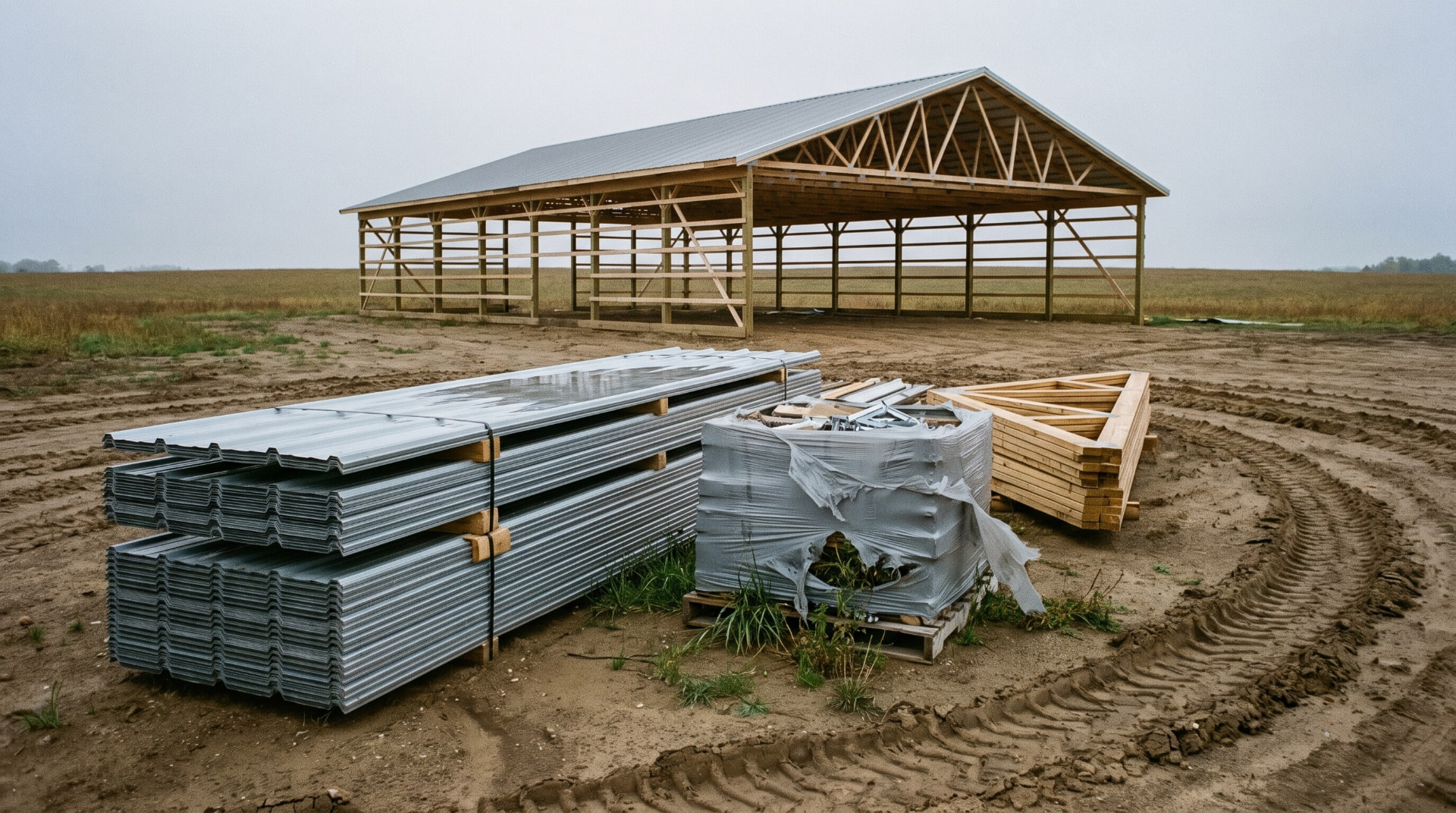
A shell package arrives on trucks. To receive it you need a driveway and a culvert that will take a loaded delivery, a pad that is finished and tested, somewhere to stack material out of the mud, and a crane date that is close behind the delivery date.
Miss any of those and the material still arrives.
- Trusses sit banded on dunnage in the weather, and the setting article covers what happens when the gap between delivery and setting stretches.
- Steel panels stacked in a field are exposed to handling damage, water between panels, and theft.
- Cash is out with nothing standing. A deposit on a building package is a real number, and it sits on your balance sheet as material in a field rather than as a building.
So the sequencing is a loop, not a line: the driveway and the pad gate the delivery, the delivery gates the crane, and the crane gates dry-in. Order against the ground being ready, not against the calendar.
A working sequence for a barndominium
| Order this | When |
|---|---|
| Utility service and transformer inquiry | Before anything. This is the real start date |
| Building package, trusses, steel | Once the permit is in hand and the pad schedule is real. Remember the erection drawings and submittal weeks stack on top |
| Overhead doors and windows | With the building package, since rough openings have to be settled before the shell is framed |
| HVAC equipment | After the Manual J, which comes after the envelope decision |
| Electrical panel and service equipment | Confirm availability early even though the panel itself is not a long pole |
| Cabinets and finishes | On the 4 to 6 month and 3 month schedule above, counting back from installation, not from today |
| Countertops | Cannot be ordered until cabinets are installed and templated |
What to ask
Your utility:
- Do you have the transformer for this service, and if not, what is its lead time?
- What is your current interval from signed easement to energized service?
Your building supplier:
- What is the lead time from signed order to delivery, and does that include erection drawings and submittal review, or does it start after them?
- What is the deposit, when is it due, and what happens to it if I need to move the delivery date?
- How long is this quote valid?
Your door and window supplier:
- What is the lead time, and at what point do you need final rough opening dimensions?
Yourself:
- What is my realistic date for a finished driveway, a tested pad, and a crane, and does my delivery date sit just behind it rather than well in front of it?
Question one is the one to make first. Everything else on this list is a schedule item. That one can be a start date.
Before you place a deposit
- Call the utility about the transformer before you order the building.
- Get the building package lead time broken into erection drawings, submittal review, and fabrication, not as one number.
- Add 2 to 6 weeks of submittal and approval to every fabricated item.
- Sort your list by what gates dry-in, not by weeks.
- Settle rough opening dimensions before ordering doors and windows, and before the shell is framed.
- Confirm quote validity and what happens to your deposit if the date moves.
- Do not schedule delivery in front of your driveway, your pad, and your crane.
- Count finish orders backward from installation, and remember countertops start after cabinets are in.
- If you are building in spring or summer, assume the busy season quote rather than the winter one.
A note on scope
This article is general education for people planning a barndominium build. Lead times are market conditions, not fixed facts, and they move with demand, region, season, and product. The commercial and industrial figures cited are published market averages for those sectors and are not residential quotes; several are driven by demand segments that do not apply to a house. Regional variation is substantial even within a single category. Nothing here substitutes for a written quote with a committed delivery date from your actual supplier and a lead time answer from your actual utility. Figures are as published in 2026.
American Barndos sells architectural design documents. We do not supply building packages, procure materials, manage schedules, or hold delivery dates, and our plan sets are not a procurement schedule.
Sources
Lead times and sequencing guidance above are drawn from the following published references, accessed September 2026. All figures are published market averages for the sectors named and are superseded by written quotes from your own suppliers.
Terrapin Construction Group, "Commercial Construction Material Lead Times 2026": lead times for structural steel with regional breakdown, insulated metal panels, pre-engineered metal building packages including the additional four to six weeks for erection drawings before fabrication, standing seam metal roofing, roofing membrane, concrete and masonry including the note on sites more than 20 miles from a ready-mix plant, medium voltage switchgear, substation transformers, the additional two to six weeks of submittal and approval applying on top of fabrication time, and the observation that on any project with a new service the electrical order date is the real project start date. https://terrapincg.com/news/commercial-construction-material-lead-times-2026
Sozio Building, "Florida Remodel Material Lead Times for 2026": residential lead times for stock, semi-custom and custom cabinets, quartz and natural stone countertops after template, imported and handmade tile, custom bathroom vanities, specialty plumbing fixtures and hardware, shower glass, and the four stage ordering sequence at four to six months, three months, six to eight weeks and two to four weeks before installation. https://www.soziobuilding.com/florida-remodel-material-lead-times-for-2026
SoCo Wood and Windows, "Understanding Lead Times: What to Expect When Ordering Windows and Doors": standard replacement window and bespoke door lead times, the four drivers of lead time including customization, manufacturer schedule, supply chain and seasonal demand, and the guidance to order as soon as design and materials are finalized. https://socoww.com/doors/understanding-lead-times-when-ordering-windows-and-doors/
Note on the commercial figures: the switchgear and transformer lead times in source one are commercial and utility scale items driven substantially by data center demand. They are included here because a rural service extension requires a distribution transformer from a constrained supply chain, not because a residential panel is a comparable item. The article states that distinction explicitly rather than letting the numbers imply otherwise.
Next step
Put this against a real plan
Every plan in the catalog has a free watermarked preview. Look at the sheets, check the span and the shop, then decide.