


Construction
The Crane Puts More Pressure on Your Ground Than the Building Ever Will
A building spreads its weight across twenty two footings over decades. A crane concentrates more than half its load onto one outrigger for an afternoon, on ground compacted for a building rather than for that.
American Barndos — September 3, 2026 — 10 min read
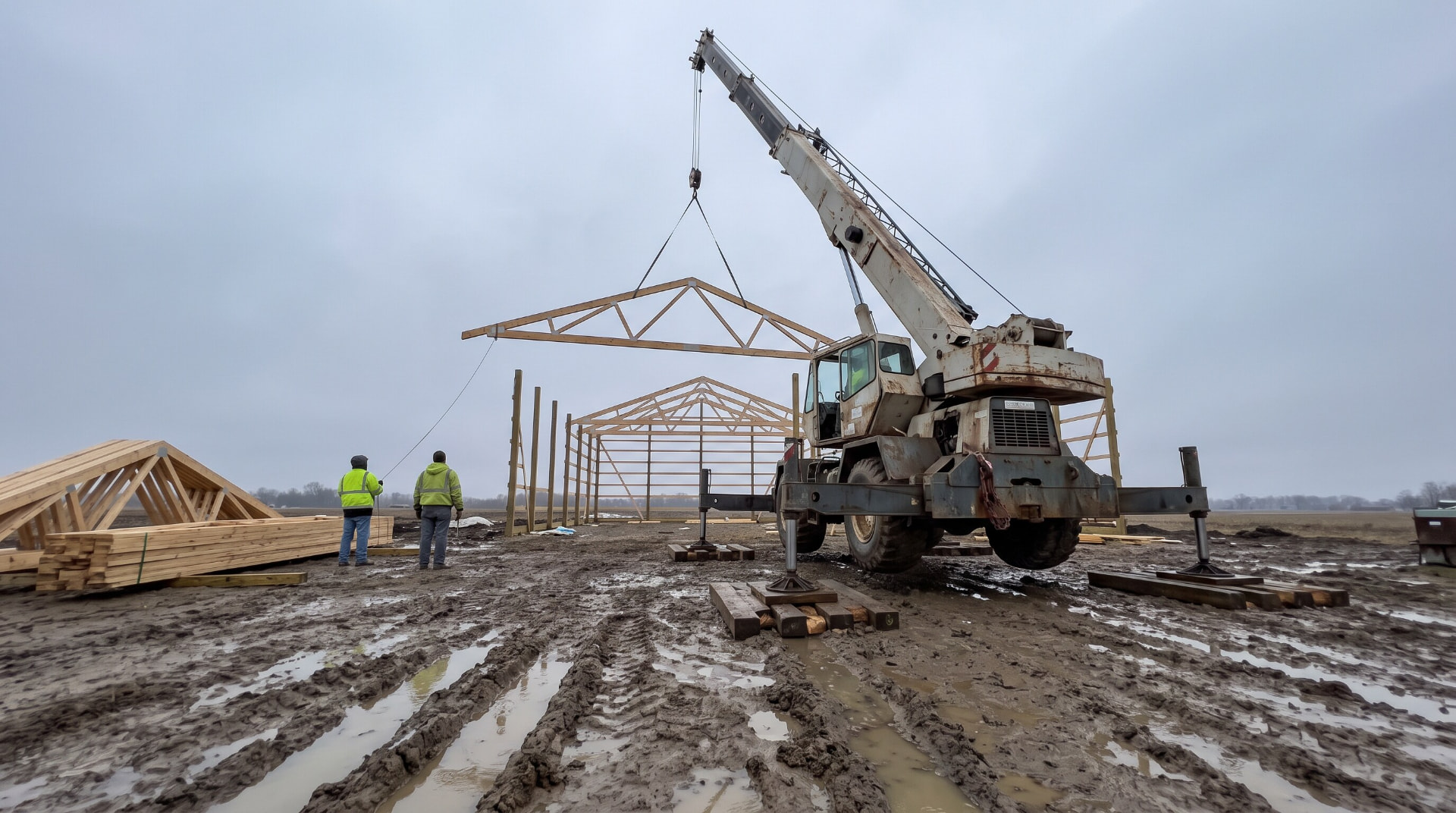
A 60 by 80 barndominium spreads its weight across twenty two footings over decades. A crane concentrates more than half its total load onto one outrigger for an afternoon, on ground somebody compacted for a building rather than for that. Add a fifteen mile an hour breeze against a fifty foot flat sail and you have the two things that cancel truss day, neither of which is inside the building.
Start here
Truss day is one day. Everything converges on it: the delivery, the lift equipment, the setting crew, the ground crew, and a weather window. It is the most schedule-fragile day in the whole build, and it fails for two reasons that have nothing to do with carpentry.
- The ground will not take the machine.
- The wind will not let the load fly.
Both are knowable in advance and both get discovered on the morning of, because nobody checked. This article is about the day. The question of who is responsible for bracing the truss system belongs to the truss engineering article and is not re-argued here.
The ground: what a crane actually does to your site
Ground bearing pressure is simple arithmetic:
Ground bearing pressure = force divided by area
Pounds over square feet, giving pounds per square foot.
The force is not evenly distributed. Where manufacturer data is not available, the working assumption is that the most heavily loaded outrigger carries roughly 50 to 60 percent of the total vertical load, and that total includes the crane, the counterweight, the load, and the rigging.
Which is why outrigger pads and mats exist. Spread the same force over more area and the pressure comes down.
The worked example
For a 120,000 pound outrigger load on compacted sand rated at 3,000 psf:
120,000 ÷ 3,000 = 40 square feet of required area, roughly a 6.5 by 6.5 foot mat.
And most engineers apply a 2 to 1 safety factor as a minimum, so the real mat is larger than the arithmetic says.
The bearing capacities crane setup works from
| Soil | Bearing capacity, psf |
|---|---|
| Dense gravel or sand | 4,000 to 6,000 |
| Hard clay | 4,000 to 6,000 |
| Compacted sand | 3,000 to 4,000 |
| Medium clay | 2,000 to 4,000 |
| Loose sand | 1,000 to 2,000 |
| Soft clay | 1,000 to 2,000 |
| Fill material | 500 to 2,000 |
And the modifier that decides a lot of truss days: saturated soil capacity can drop to 50 percent or less of the dry value.
Now read that table against your own site
Look at the bottom row. Fill material, 500 to 2,000 psf.
Your building pad is engineered fill. It is the flattest, best drained, most convenient ground on the property, it is exactly where a crane operator would like to set up, and it is the row on that table with the lowest listed capacity, potentially below the 1,500 psf the residential code assumes for your footings.
That is not a reason to panic and it is not a claim that a crane cannot work off a pad. Compacted engineered fill placed and tested properly performs well, and the compaction article covers what "properly" means. It is a reason to have the conversation before the machine is on the road, because the operator is going to ask what the ground is, and "we brought in fill" is a different answer from "it was tested to 95 percent Standard Proctor and here is the report."
And this is where the compaction testing paperwork earns its money a second time. Those daily field density reports are the evidence that answers the crane company's question.
OSHA 29 CFR 1926.1402 requires that ground conditions at crane setup locations be assessed, and that the crane be set up on a firm, adequately drained, and graded surface. That is a requirement on the employer, not a suggestion, and an operator who declines to set up on ground they do not trust is doing their job correctly.
Two more site dependencies fall out of this:
- The machine has to physically get there. That means the driveway and the culvert, which is covered in the utility hookups article. A crane that cannot cross the ditch is a crane that goes home.
- Rain matters more than it looks. Not because anyone minds working wet, but because saturated ground can lose half its bearing capacity. Two days of rain before truss day is a ground problem, not a comfort problem.
The wind: why the number is lower than you think
Wind is the other cancellation, and the thresholds are specific.
A practical three zone framework:
| Zone | Wind |
|---|---|
| Normal operations | 0 to 15 mph |
| Caution | 15 mph up to the manufacturer limit |
| Stop work | At the manufacturer limit, immediately |
For mobile and rough terrain cranes, the operational threshold is commonly around 20 mph gust speed at the boom head, subject to the wind area of the load.
Two details matter more than the headline number.
Gusts control, not sustained wind. Manufacturers commonly define permissible wind speed using a 3 second gust at maximum hoist height, not an average. The forecast number you looked at this morning is not the number that governs.
Sail area drives it down. Large flat loads catch wind like a sail and generate lateral forces that can exceed rated capacity. Published guidance is to recalculate the permissible wind speed downward for loads above a defined wind area per unit of weight, and as a practical rule to reduce the operational wind limit by 5 to 10 miles per hour for high sail area loads.
Now think about what a wood roof truss is. Fifty or sixty feet long, twelve to sixteen feet tall at the peak, a few inches thick, and remarkably light for its area. It is very close to a pure sail. The realistic stop-work wind on truss day is meaningfully below the 20 mph headline, and the reduction is exactly the adjustment that guidance describes.
OSHA 29 CFR 1926.1417 does not set a universal wind limit. Employers must follow the manufacturer's procedures, which makes the operator's manual the effective legal baseline.
Which settles the argument that happens on site at 7 a.m. The right answer to "can we push it" is whatever the operator says, and an operator who calls it is not being difficult. They are following the only standard that actually applies.
The part nobody writes about: truss day is priced by the day, and it has no backup
Here is the money consequence that makes all of the above worth planning around.
| Item | Typical published cost |
|---|---|
| Crane or equipment rental | $200 to $700 per day |
| Setting labor | $40 to $60 per truss |
On a 60 by 80 building at 8 foot spacing, twenty two trusses is roughly $880 to $1,320 in setting labor, on top of the machine.
But the rental line understates the exposure, because truss day is a convergence. The delivery is scheduled. The machine is scheduled. The setting crew is scheduled. The ground crew is scheduled. A wind day or a wet day does not cost you a few hours. It costs the mobilization, and it costs whatever the next available date is for four different parties.
Meanwhile the trusses are already on your site, banded, stacked on dunnage, sitting in the weather, and every day they sit is a day something can happen to them.
So the mitigations are all scheduling decisions made weeks earlier:
- Build the driveway and the culvert before you book anything. Access first.
- Confirm the crane setup location and the ground under it, with the compaction reports in hand.
- Watch the forecast three days out, and watch gusts rather than sustained wind.
- Have a plan for the truss stack if the set slips: covered, blocked up off the ground, banded.
- Do not book the machine before the ground is ready. A confirmed date on unready ground is a deposit you are going to argue about.
Crane or telehandler
Both are common on post frame and the choice is not obvious.
A telehandler is frequently adequate for post frame spans and truss weights, it is often already on site, and it is cheaper. Its limits are reach and the height it can place a truss at, and it needs to get close to the building.
A crane buys reach, height, and precise control, which matters as spans and eave heights grow, and it lets the machine stand further back from the building.
Both put concentrated loads into your ground. A telehandler on tires in soft ground is its own problem, just a different geometry from an outrigger. The ground conversation above applies to whichever machine shows up.
Let the truss supplier and the setting crew make this call against your actual span, truss weight, and eave height, and ask them what the machine needs underneath it.
One line on bracing, and then read the other article
The first truss has nothing to brace against, which makes it the most hazardous single lift of the day, and temporary installation bracing during erection is the contractor's responsibility under the industry standard.
That subject, including who owns permanent bracing and why post frame spacing sits outside the standard prescriptive guidance, is covered properly in the truss engineering article. Read it before this day rather than after.
What to ask
Your crane or setting contractor:
- What ground bearing pressure does your setup require, and where exactly do you want to be positioned?
- Do you want to see the compaction test reports for the pad?
- What is your wind limit for this load, and are you measuring gusts at the boom head?
- What is your policy and charge if we lose the day to weather or ground?
- Crane or telehandler for this span and eave height, and why?
Your excavation contractor:
- Is the driveway and culvert able to take a loaded crane and a truss delivery truck?
- Where on this site is there firm, drained, graded ground for a setup, and is it on the pad or off it?
Your truss supplier:
- What does each truss weigh, and what is the delivery date relative to the set date?
Question four is the one to settle in writing before the deposit, because the day you need that answer is the day everyone is standing in your field looking at the sky.
Before you book the crane
- Finish the driveway and culvert first. Access is the precondition for everything else.
- Identify the setup location and know what the ground under it is.
- Have the compaction reports available, because you will be asked.
- Remember that engineered fill is on the low end of the crane bearing table and that saturation can halve it.
- Confirm the wind limit for your specific loads, and understand it will be below the general number because a truss is a sail.
- Watch gusts, not sustained wind, in the three days before.
- Minimize the gap between truss delivery and truss setting.
- Get the weather and ground cancellation terms in writing.
- Read the truss engineering article before the day, not after.
A note on scope
This article is general education for people planning a post frame or barndominium build. Crane setup, ground assessment, lift planning, and wind limits are governed by OSHA regulation, the equipment manufacturer's procedures, and the judgment of qualified personnel, and nothing here substitutes for any of those. Soil bearing values cited are typical published figures used in crane setup planning and are not a substitute for a geotechnical assessment or the crane company's own evaluation of your site. Wind thresholds vary by machine, configuration, and load, and the operator's manual is the governing document. Cost figures are typical published ranges as of 2026.
American Barndos sells architectural design documents. We do not plan lifts, assess ground conditions, supervise erection, or provide safety direction, and our plan sets are not an erection plan.
Sources
Formulas, bearing values, wind thresholds, regulatory citations, and costs above are drawn from the following published references, accessed September 2026. All values are typical published figures and are superseded by the crane manufacturer's procedures, your crane company's site assessment, and applicable OSHA regulation.
CraneCheck, "Crane Ground Bearing Pressure: Calculations, Mat Requirements and Site Assessment": the ground bearing pressure formula, the assumption that the most heavily loaded outrigger carries approximately 50 to 60 percent of total vertical load including crane, counterweight, load and rigging, allowable bearing capacities for dense gravel and sand, compacted sand, loose sand, hard, medium and soft clay, fill material and saturated soil, the mat sizing worked example and the 2 to 1 minimum safety factor commonly applied, and the OSHA 29 CFR 1926.1402 requirement that ground conditions be assessed and the crane set on a firm, adequately drained and graded surface. https://cranecheck.co/blog/crane-ground-bearing-pressure-calculations
Central Florida Crane Service, "Wind Speed Limits for Crane Operations": the three zone operational framework of normal, caution and stop work, the approximate 20 mph gust at boom head threshold for mobile and rough terrain cranes, the tower crane in service and assembly benchmarks, the effect of large flat loads acting as sails and the recommendation to reduce the operational wind limit by 5 to 10 mph for high sail area loads, the treatment of gusts as the controlling measurement using a 3 second gust at maximum hoist height, and the note that OSHA 29 CFR 1926.1417 sets no universal limit and defers to manufacturer procedures. https://centralfloridacraneservice.com/feeds/blog/steel-erection-wind-speed-crane-operations
HomeGuide, "How Much Do Roof Trusses Cost? (2026)": setting labor per truss and crane or equipment rental per day. https://homeguide.com/costs/roof-truss-prices
Note on the fill material observation: the comparison between the crane setup bearing table's fill material range and the residential presumptive bearing value is drawn here from source one's published table alongside the presumptive values cited in the soils article. It is offered as a question to raise with your crane company rather than as a published finding, and their site assessment governs.
Founding list
Join the founding list.
The catalog opens to the founding list first, at founding pricing, before it goes public.
Keep reading
- ConstructionIn a Post Frame Building, Bad Compaction Does Not Fail the Building. It Fails the Floor.
- ConstructionIn post frame you pour the floor last, inside a finished building, and everything under it is permanent
- ConstructionYour Steel Skin Is a Vapor Barrier on the Cold Side, Which Is Exactly the Wrong Place for One